Solo Ecstatic Dance at Home: How to Build a Practice That Actually Moves You
No floor, no crowd, no problem. Here's how to bring ecstatic dance into your living room and make it a real practice—not just a playlist.
 ▶ See upcoming dances
So you've tasted it — maybe at a community event, maybe at one of Sedona's local floors — and now your body wants more between the big nights out. Or maybe you're brand new and you'd like to try moving freely before you show up anywhere. Either way, you're asking the right question: can you build a solo ecstatic dance practice at home, and will it actually do anything? Short answer: yes and yes. Long answer: keep reading, because there's a small art to it.
Why Would I Dance Alone at Home Instead of Just Going to a Class?
Ecstatic dance isn't a class. There's no choreography to learn, no teacher timing your pliés, no one watching your footwork. It's free movement — your body responding to sound without a script. That means the whole thing is portable. Your living room is a perfectly valid floor.
The solo home practice fills a different need than the community event. When you go out, you get the collective energy — dozens of bodies moving together create a kind of invisible current you can surf. That's real and irreplaceable. But at home, you get something else: total privacy, zero performance pressure, and the ability to go into the weird, tender, ridiculous, grief-stricken, or ecstatic corners of your body without a single witness. Some of the deepest movement happens when no one is watching — including when no one is watching you watching yourself.
How Do I Set Up a Space That Actually Works?
You don't need much. Clear a patch of floor big enough to take three steps in any direction and fall down safely. That's your minimum. Push the coffee table to the wall, roll up the rug if it's grabby, and decide: shoes or barefoot? (Barefoot usually wins — your feet can actually feel and respond to the ground.)
A few other things worth considering:
- Sound quality matters more than you think. Tinny laptop speakers flatten the low frequencies that move your hips and chest. Even a modest Bluetooth speaker makes a surprising difference. Headphones work too — they create an almost psychedelic sense of immersion.
- Lighting is a secret ingredient. Harsh overhead lights keep your nervous system in task mode. Dim it, use a lamp, light a candle. Your body relaxes faster in softer light, and that relaxation is the door.
- Mark a beginning and an end. Without the structure of a facilitated event, it's easy to drift in and drift out without really going anywhere. A simple ritual — three deep breaths before you press play, a moment of stillness when the music ends — signals to your body that this time is intentional.
What Music Should I Actually Use?
This is where a lot of home dancers get stuck. They open a streaming app, stare at infinite options, pick something they like, and then find themselves nodding along instead of moving. The trick is to find music that has an arc — the same wave structure that a skilled ecstatic dance DJ builds over a live event.
The classic wave looks something like this: a slow, earthy opening (think ambient textures, acoustic instruments, gentle rhythm) that invites you to arrive in your body. Then a gradual build — rhythm gets more insistent, BPM rises, beats layer in. Then a peak: full-on, body-moving, can't-help-it sound. Then a descent — the music loosens, opens out, softens. Then stillness or near-silence for integration.
Many ecstatic dance DJs post long-form mixes online designed exactly for this. Search for "ecstatic dance mix" or "conscious dance journey" and look for recordings that run forty-five minutes to two hours. The length matters because your body needs time to actually let go — it rarely happens in the first ten minutes.
What Do I Actually Do Once the Music Starts?
Nothing. Wait — that sounds wrong. What we mean is: don't decide in advance. Don't plan a move, don't warm up with jumping jacks, don't tell yourself you'll "do" anything. Start standing. Feel your feet. Let the music come in through your ears and notice what it nudges in your body. Maybe a shoulder wants to roll. Let it. Maybe your weight wants to shift. Follow that.
The whole practice is a conversation between sound and sensation. Your only job is to keep listening — to the music and to your body — and to keep saying yes to what you notice. If nothing's happening, that's data too: sway, breathe, wait. The body usually catches up once it trusts you're not going to judge it.
Some nights you'll sweat through your shirt and feel like you've processed a year of emotions. Some nights you'll mostly sway and feel pleasantly calm. Both are the practice.
How Does My Home Practice Connect to Dancing in Community?
They feed each other. Your solo sessions build a kind of inner vocabulary — you get to know which parts of your body hold tension, what rhythms release it, where you tend to get stuck. Bring that self-knowledge to a community floor and you drop in faster, go deeper, ride the collective wave with less self-consciousness.
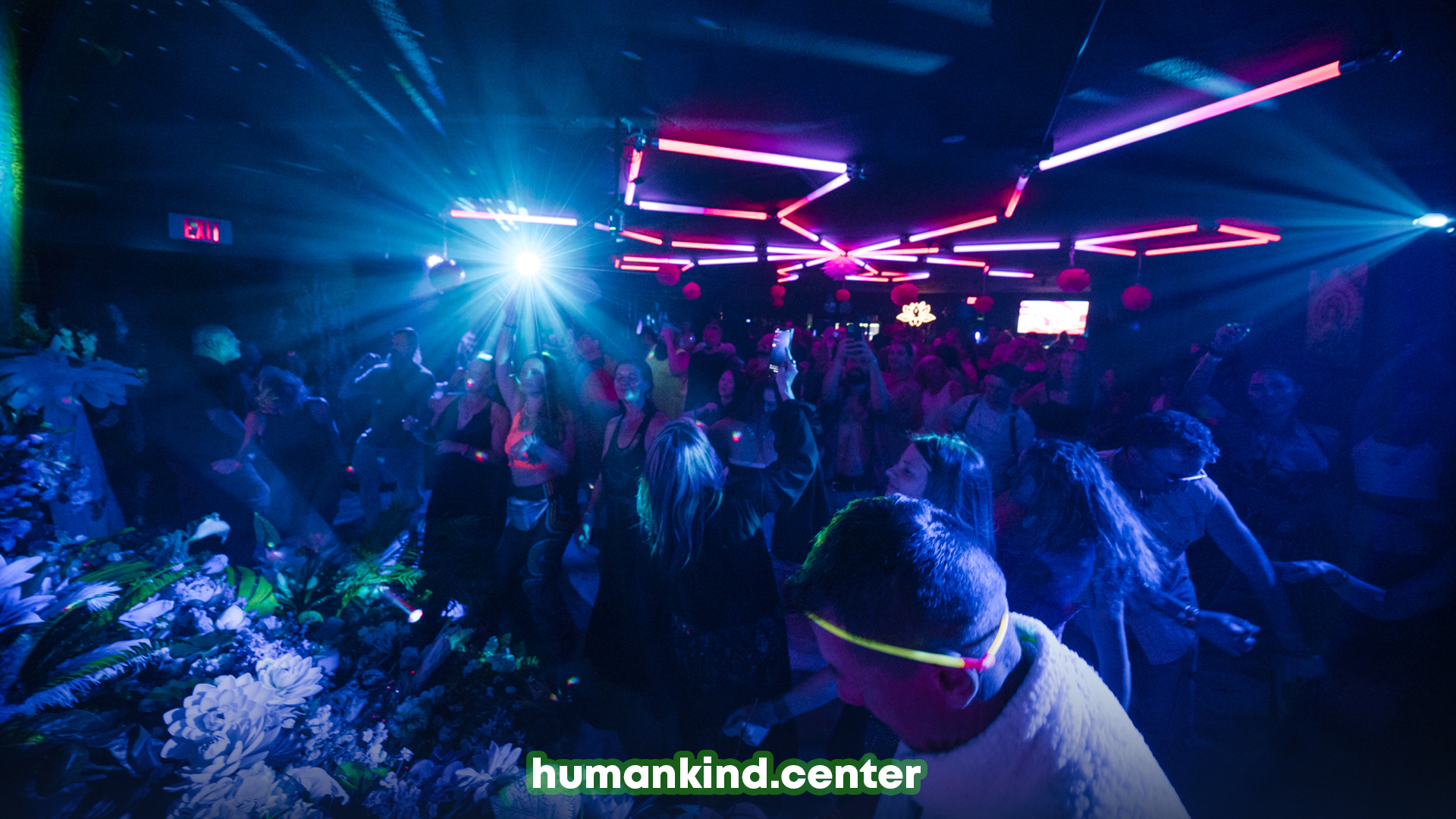
And after a big community night — like the events at humankind in Sedona — going home and doing even a short solo integration can help you metabolize whatever moved through you. Twenty minutes of quiet movement the next morning can land something that didn't quite land on the floor.
The floor is everywhere your feet are. The practice is whenever you say it starts. All you need is sound, space, and the willingness to find out what your body already knows.
Dance with us at humankind
Sedona's biggest conscious dance floor — ecstatic dance, DJs, and dance parties at humankind, all ages welcome.
Can't make it in person? Every event streams live and on demand in the humankind app.