Dance Your Feelings: What Free Movement Does to Your Nervous System (It's Wild)
Free movement isn't just fun — it's nervous system medicine. Here's the real science behind why ecstatic dance leaves you feeling so deeply, gloriously reset.
 ▶ See upcoming dances
If you've ever ugly-cried on a dance floor, shaken like a wet dog for no obvious reason, or walked out of an ecstatic dance feeling like someone rebooted your entire operating system — congratulations, your nervous system was doing exactly what it's built to do. Dance your feelings: free movement and your nervous system is not a metaphor. It is literal, physical, measurable biology, and it is absolutely available to anyone willing to show up and let their body lead for an hour or two.
Here's what's actually happening under the skin, and why it keeps so many people coming back to the floor.
What Is Your Nervous System Actually Doing When You Dance?
Your autonomic nervous system runs the background show: heart rate, digestion, breath, the whole survival suite. It has two main gears — sympathetic (go-go-go, threat-response, the one that's basically always on in modern life) and parasympathetic (rest, repair, digest, feel safe). Most of us live chronically parked in sympathetic overdrive without even knowing it.
Rhythmic, repetitive movement — the kind that naturally emerges when you stop trying to look cool and just follow the music — activates the parasympathetic system and stimulates the vagus nerve, the long wandering nerve that connects your brain to your heart, lungs, and gut. Vagal tone is basically your body's emotional shock absorber, and dance tones it beautifully. The result is a nervous system that is simultaneously more alive and more at ease. Both. At once. Which is kind of magical.
Add a room full of other humans moving freely, and you also get a healthy hit of oxytocin — the bonding neurochemical — without needing to say a single word to anyone.
Why Does Free Movement Release Emotions That Talk Therapy Sometimes Can't?
The body keeps score, as the saying goes. Stress, grief, old fear, unspent adrenaline — these don't just disappear because you've intellectually processed something. They live in the fascia, the hips, the jaw, the chest. Talk therapy is brilliant for narrative and meaning-making, but it operates primarily through the cortex — the thinking brain. Emotions, though, are subcortical. They live deeper, and they respond to body-based input more readily than words.
Free movement bypasses the analytical filter. When you give your body full permission to move however it wants — fast, slow, tiny, enormous, ridiculous, tender — it starts completing cycles of emotion that may have been stuck mid-loop for years. That's why it's completely normal to suddenly feel like laughing for no reason, or to have tears arrive out of nowhere during a slow ambient track. Nothing is wrong. Everything is working.
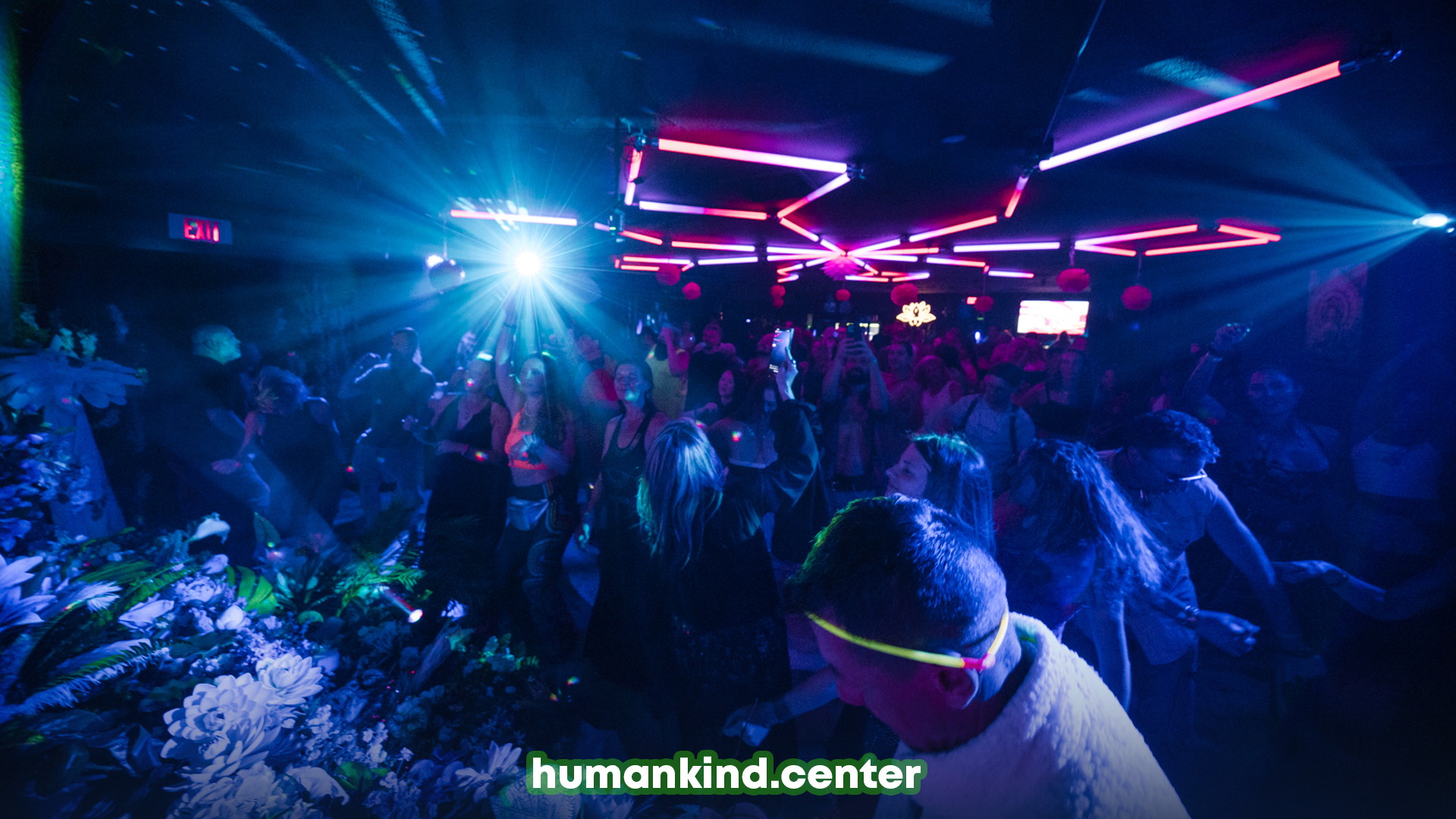
This is also why ecstatic dance floors tend to have a particular quality of permission. You'll see people trembling, people spinning, people moving about two centimeters in any direction with their eyes closed. All of it is valid. All of it is the nervous system doing its job.
Why Is Nobody Talking — and Why Does That Actually Help?
The no-talking guideline that most ecstatic dance events hold isn't about being antisocial. It's neurological strategy. The moment you open your mouth to chat, your prefrontal cortex takes the wheel. You're back in your head, managing impressions, choosing words, tracking the other person. The somatic spell breaks.
Silence on the floor keeps you in your body. It keeps the nervous system in the driver's seat. It also creates a rare kind of social intimacy — sharing space with other humans without the usual transactional layer of conversation. Many dancers find this profoundly calming in a way that's hard to articulate but immediately felt.
What Do I Wear, and Does Any of This Require Skill?
Zero skill required. We cannot stress this enough. Ecstatic dance is explicitly non-choreographed — there are no steps to learn, no right way to move, no moment where an instructor corrects your posture. The only technique is listening to your body and following it.
Wear whatever you can move freely in. Layers are useful because you'll likely warm up quickly. Bare feet are common and beloved (and kind to the floor). Leave the shoes at the door if the venue allows it — proprioception, your body's sense of where it is in space, goes way up when your feet can actually feel the ground. That ground connection matters for nervous system regulation more than you might expect.
If you're new to the whole world and wondering where to start, here's a solid guide to ecstatic dance in Sedona that lays out what to expect before you ever set foot on a floor.
How Often Do I Need to Dance to Actually Feel the Difference?
Good news: even one session creates a measurable shift. Most people walk out of their first ecstatic dance feeling lighter, clearer, and slightly bewildered in the best possible way. That said, like any somatic practice — yoga, breathwork, cold plunging — the benefits compound with regularity. A nervous system that gets consistent opportunities to discharge and reset starts to build a new baseline. Less reactive. More resilient. Easier to actually feel joy when joy is available.
Even once a month makes a noticeable difference for most people. Once a week is where things tend to get transformative.
If you're in the red rock country and want to feel all of this firsthand, humankind's dance nights in Sedona are a beautiful place to begin — a welcoming, no-judgment floor held with genuine care for the experience of every body in the room.
Your nervous system has been waiting for this. The floor is ready when you are.
Dance with us at humankind
Sedona's biggest conscious dance floor — ecstatic dance, DJs, and dance parties at humankind, all ages welcome.
Can't make it in person? Every event streams live and on demand in the humankind app.